PROJECT ORAN
—
MTGST
UX / UI
AI
A task manager built for AI delegation: humans stay in control of the board, agents take the subtasks they are trusted with
Taken from a blank page to a working agent orchestrator through a fully documented, AI-assisted concept-to-development process.
CONTEXT
ORAN is currently in active development. It is a Kanban-style task manager for human and AI collaborative work. Every task added is auto-triaged by an LLM into steps labeled human or agent-doable: research-type steps run on their own, while consequential actions (send, pay, post, delete) park on approval gates on the board. Agents execute through a managed runtime and share a permissioned memory that compounds week over week.
WHAT I DID
The part I am proudest of is the process. ORAN went from a vague idea to build-ready in six days of structured definition work: eleven phases covering vision, competitive landscape, use cases, the object model, a dedicated memory and privacy system, frozen MVP cut lines, a live integration spike, architecture, a per-domain PRD set, wireframes with a full design system, and a build plan. Every choice landed in an append-only decision log, and a reversal means a new entry, never a silent edit.
Product definition: three personas with end-to-end journeys, positioning researched against ten incumbents, a pre-registered kill signal for the design-partner pilot, and scope so frozen that any addition must name what leaves in exchange.
Trust model: one gate primitive for every human decision, and five non-negotiable floors written as code constants (never auto-approve, secrets never in memory, restricted data means a human gate per access). Nothing enters memory silently.
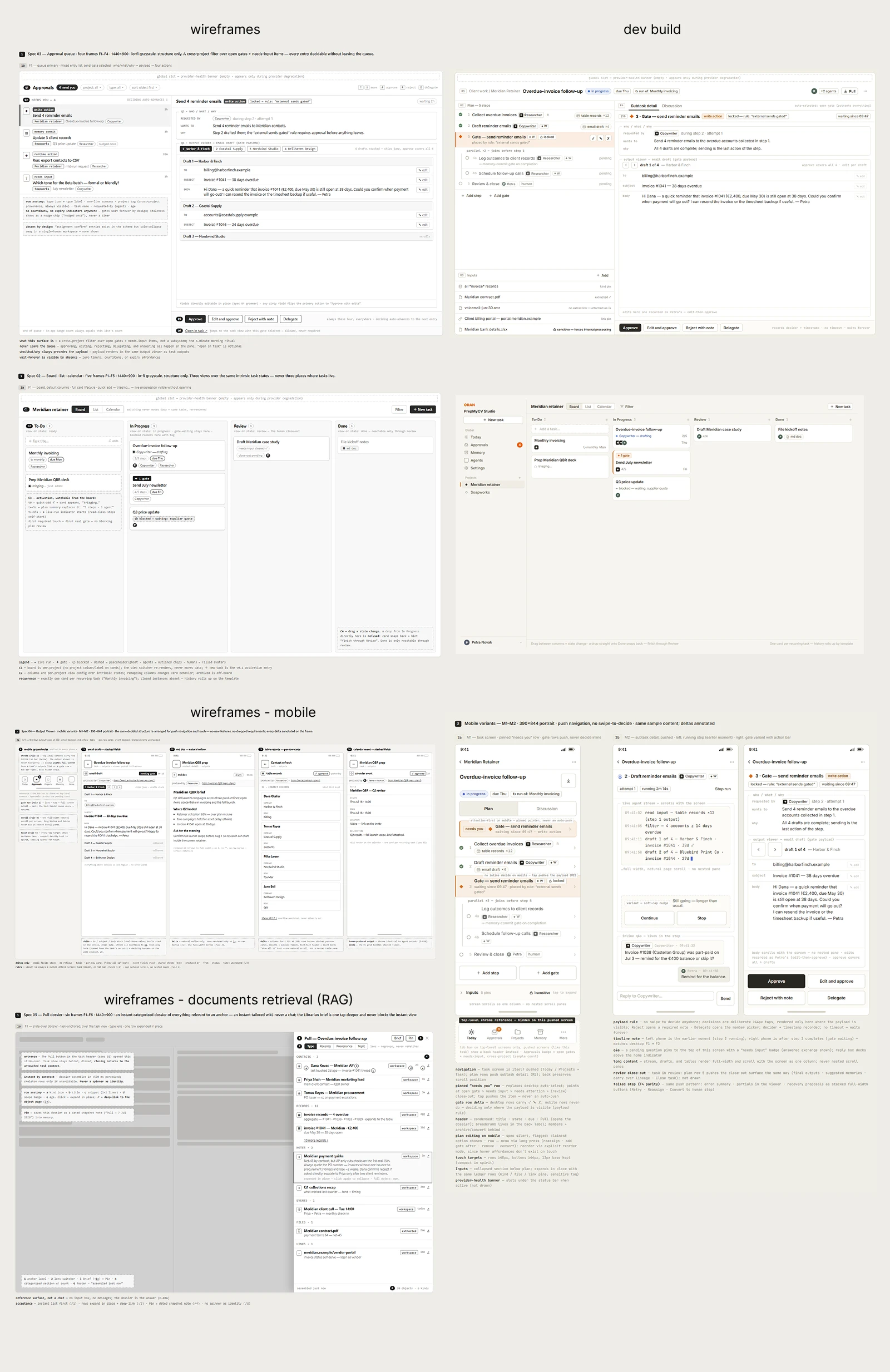
Design: wireframe specs for every core screen (33 exported frames) and a 37-component design system where the brand orange has exactly two jobs: the wordmark, and marking that a human decision is required. Token changes require a decision entry.
The build method: plan expensive, execute cheap. Planner and reviewer agents author one plan file per work package, executor agents implement exactly one plan per session, risky diffs get an adversarial review, and I hold merge authority. The first five build days closed 51 work packages against a plan that estimated 9 to 14 months at human pace.
Quality by real runs: every milestone closes with a live exit demo against the real runtime and real model spend, never mocks. These demos caught milestone-critical bugs that roughly 1,300 green tests had missed.
IMPACT
From blank page to a working agent orchestrator (live runs, approval gates, permissioned memory) in under two weeks
118 logged decisions and 237 documents (~364,000 words): the entire reasoning trail is auditable
A 37-component design system and full wireframe set produced before the first build commit
v0.1 headed to recruited design partners with a pre-registered kill signal instead of vanity metrics
Happy to walk through the whole process, from first decision to live demo, in person or on a video call.
MY ROLE
Lead Product Designer, Product Owner, architect
DURATION
July 2026 – present (in active development)
TOOLS USED
Claude Code, Claude (Fable 5, Opus, Sonnet), Claude Design, Hermes Agent, TypeScript, React, Fastify, PostgreSQL, pgvector, Backlog.md, GitHub Actions